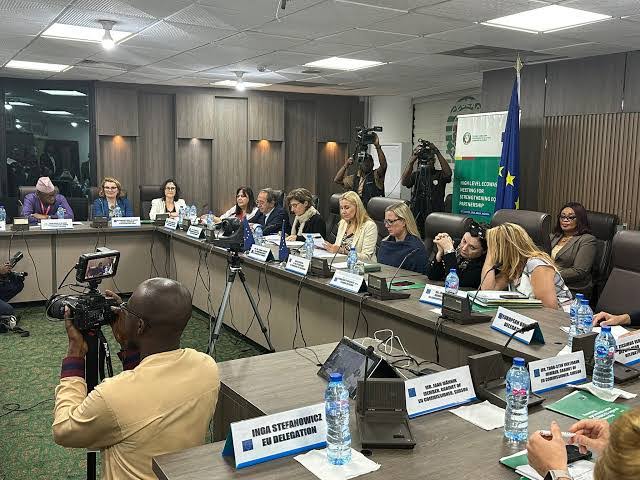
The European Union and the Economic Community of West African States (ECOWAS) have signed seven agreements worth €212.4 million on promotion of trade and regional integration, energy interconnectivity and renewable energy.
The agreement on
Thursday, October 19 also covered affordable and clean energy,
sustainable food system, food security as well as migration.
Leader of the EU team and European Commissioner for International Partnerships, Jutta Urpilainen, met with the President, ECOWAS Commission, Omar Alieu Touray, in Abuja for the signing of the agreements. Also present was the European Commissioner for Energy, Kadri Simson.
Urpilainen said EU was a long term supporter of regional integration that produces prosperity through added value.
Urpilainen
stated that the agreements have a central role of stabilizing the
region through promotion of democracy, rule of law and economic
cooperation.
The breakdown of agreements include support to
free movement of persons and migration, €34 million. This is for
maximizing the development potential of free movement of persons and
migration within a more secure and rights-based Economic Community of
West African Countries in the context of regional integration process.
This would be achieved by supporting the effective implementation of
ECOWAS free movement Protocol and ECOWAS Common Approach on Migration at
the regional, national and local levels. African Trade Competitiveness
and Market Access was supported with €50 million.
The third
agreement, which was in the area of trade in services in Sub-Saharan
Africa, has €l1.5 million. It was to aid increasing the liberalization
of services and exports for selected services sectors.
There
was also support programme for specialized ECOWAS organizations active
in the energy sector to develop the regional electricity market and
operationalize its interconnected grid and increase the share of
renewable energy in the energy mix.
“Regional Clean Cooking Action in West Africa – ReCCAWA, E12 million, for increasing access to clean, efficient, sustainable and affordable cooking energy solutions in West Africa by strengthening the clean cooking enabling framework at regional and national scales, by proposing innovative financing and promoting business models that will scale-up the supply, dissemination and adoption of clean cooking solutions, and by creating and disseminating evidence-based data and knowledge that will contribute to the governance of the West African cooking sector" the EU Commissioner said.


No comments:
Post a Comment